- Abhishek Banerjee, Aparshakti Khurana to Siddhant Chaturvedi: Bollywood Actors & Their Love for Black Outfits
- Rajshri productions and bhamla foundation come together to honour 300 asha workers – the unsung women heroes of our society – with a special screening of ‘yeh prem mol liya’
- Jawaani Jaaneman to Srikanth: Birthday Girl Alaya F’s Evolution as a Dynamic Actress
- Accountability to Be Fixed at Panchayat Level to Prevent Child Marriages: Prahlad Patel
- बाल विवाह रोकने के लिए पंचायत स्तर पर तय होगी जवाबदेही: प्रह्लाद पटेल

Accountability to Be Fixed at Panchayat Level to Prevent Child Marriages: Prahlad Patel
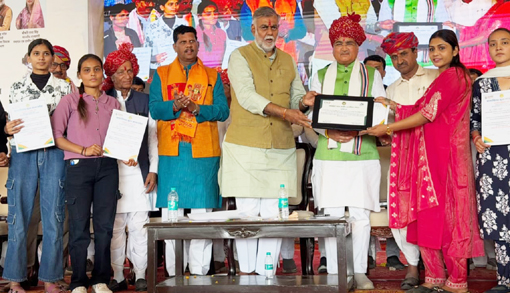
Indore, 27 November 2026: With the resolve to make Madhya Pradesh child marriage-free, a massive public gathering was organised in Jirapur of Rajgarh district on the occasion of the International Day for the Elimination of Child, Early and Forced Marriage. Thousands took a pledge to eradicate child marriage under the leadership of the chief guest, Prahlad Patel, minister for Panchayat and Rural Development. On the occasion, Patel announced that accountability for preventing child marriage would be fixed at the panchayat level.
Bal Vivah Mukti Raths were also flagged off during the programme, and a large number of balloons were released into the sky to highlight collective commitment against the practice. Additionally, seven child marriage survivors were felicitated. The programme was jointly organised by the department of Panchayat and Rural Development and Just Rights for Children (JRC), India’s largest civil society network working for the protection of children.
The state-level launch of the ‘Nayi Chetna 5.0’ gender campaign was also held during the programme. This year’s theme is ‘From Access to Empowerment: Women’s Empowerment through Livelihoods and Equal Opportunities for a Developed India’. The four-week campaign, running from November 25 to December 23, aims to go beyond merely providing women access to services and opportunities, instead strengthening their economic identity, contribution to livelihoods, and participation in decision-making processes.
The campaign will particularly focus on recognising and acknowledging women as economic contributors; increasing their access to land and property rights, credit and banking facilities, and digital financial services; ensuring safe public spaces and mobility; and challenging gender discrimination associated with unpaid care work. On the occasion, a gender alphabet book and the campaign’s weekly activity calendar were also released.
Hazari Lal Dangi, MLA from Khilchipur; Minister of State Gautam Tetwal; and Rodmal Nagar, Member of Parliament from Rajgarh, also participated in the programme. During the event, Sunita Solanki and Nikita, who stopped their own child marriages and continued their education, shared their experiences. Sunita spoke about her struggle to get her child marriage declared null and void and highlighted the need to eliminate this social evil, while Nikita recalled how she stopped her marriage and resumed her studies. Recognising their courage and determination, they were felicitated along with five other girls: Dhapu, Nisha, Khushi Tanwar, Khushi Verma, and Maya Lavvanshi. Additionally, certificates of appreciation were awarded to the ‘Lok Adhikar Kendra’ units in Rajgarh and Khilchipur for their notable work in the field of child protection.
Addressing the gathering, chief guest Prahlad Patel said, “Accountability for preventing child marriages will be fixed at the panchayat level. Every sarpanch will be required to maintain a marriage register so that records of every marriage taking place in the village are available. Gram sabhas in which not a single case of child marriage is reported will be honoured.” He also noted that collaborative efforts with the government and law enforcement agencies across communities, schools, panchayats, women’s groups, religious leaders, and local institutions are playing a vital role in preventing child marriages.
“This change has not been possible through the efforts of any one individual, but through everyone’s collective efforts. The government and administration strictly enforced the law, panchayats and civil society organisations maintained vigilance in villages, teachers ensured that children remained connected to schools, and women and young people spread awareness in society. Civil society organisations also worked at the grassroots level,” Patel added.
He further said that under the Madhya Pradesh State Rural Livelihoods Mission, about 313 Lok Adhikar Kendras are operating across 55 districts of the state to promote the rights, safety, and gender equality of women and adolescent girls. Through these centres, women and adolescent girls receive assistance, counselling, and access to justice against domestic violence, discrimination, and social evils.
A total of 1,59,250 cases have been received by Lok Adhikar Kendras so far, of which 1,21,554 have been resolved. To extend these efforts to the village level, more than 6,600 trained gender sakhis and gender community resource persons are actively working. Self-help groups, village organisations, and cluster-level federations are also continuously working to promote women’s rights, leadership development, participation in decision-making processes, and the elimination of social evils.
Manish Sharma, national secretary of Just Rights for Children, said, “Over the past three years, through our collective efforts and in collaboration with the administration, more than 6.5 lakh child marriages have been prevented across the country. JRC is working towards the elimination of child marriage across the country, including in all districts of Madhya Pradesh. The campaign is receiving full support from the government and administration. The government and administration are committed to achieving the goal of ending child marriage by 2030. JRC was the first to propose the declaration of an International Day for the Elimination of Child Marriage. On 4 September, the United Nations accepted this proposal and declared 27 November as the ‘International Day for the Elimination of Child, Early and Forced Marriage’. This is proof that a campaign which began in India has today taken the shape of a global movement.”
More than 300 partner organisations of Just Rights for Children are working at the grassroots level towards eliminating child marriage across 782 districts in the country. According to the National Family Health Survey (NFHS-6), the percentage of women aged 20–24 years who were married before the age of 18 stood at 23.3 per cent in 2019–21, declining to 20.1 per cent in 2023–24. In Madhya Pradesh, this figure dropped to 20 per cent in 2023–24 from 23.1 per cent in 2019–21. About 14 partner organisations of JRC are working across all 55 districts in the state to promote child protection and child rights. Since April 2023, the network’s efforts have helped prevent more than 62,000 child marriages in the state.