- पार्वती से पू तक, नायरा एम. बनर्जी ने तय किया लंबा सफर: हर किरदार के साथ खुद को नए सिरे से गढ़ रही हैं अभिनेत्री
- From Parvati to Poo, Nyrraa M Banerji Has Come a Long Way: The Actress Continues to Reinvent Herself with Every Role
- Shakti Pumps Unveils 620 Wp Shakti On Roof Solar Modules at REI Expo 2026, Strengthens Integrated Clean Energy Portfolio
- Janhavi is young, but she is far from naïve. Where does she get the confidence to question people and established systems?
- Aditi Rao Hydari meets her comic side in Parivarik ManuRanjan

Electric garbage trucks in India’s cleanest city run at less than a third of diesel’s fuel cost, ICCT–MANIT study finds
New ICCT and MANIT study finds electric buses use 54% less energy per km and electric waste collection trucks use 91% less energy per km than diesel counterparts, with total cost of ownership already favoring electric vehicles in both cases.
New Delhi, 5th October 2026 – Electric buses and electric door-to-door (D2D) waste collection municipal trucks operating in Indore, Madhya Pradesh, are outperforming their diesel and CNG counterparts on energy use, lifecycle emissions, and total cost of ownership, according to a new study released today by the International Council on Clean Transportation (ICCT) and Maulana Azad National Institute of Technology (MANIT).
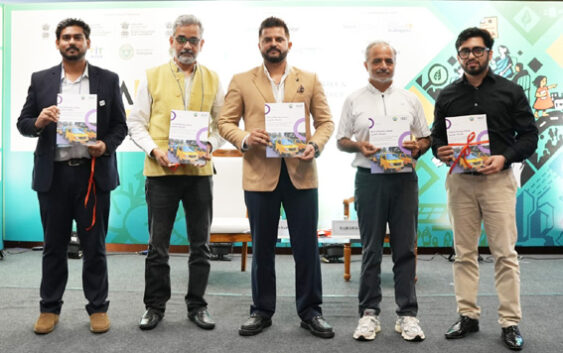
(From left) Aviral Yadav, Researcher, ICCT, Amit Bhatt, India Managing Director, ICCT, Suresh Raina, Former Indian International Cricketer, Rajesh Kalra Former Executive Chairman of Asianet News, former Chief Editor of Times Group Digital and Kshitij Rampotra, Researcher, ICCT
Launched at Urban Adda 2026, this is the first comprehensive real-world performance assessment of electric buses and electric waste collection trucks operating simultaneously in an Indian city. It draws on telematics records, charging and fueling logs, and vehicle specifications from a subset of Indore’s electrified public fleet, which includes 49 electric buses run by Atal Indore City Transport Service Limited (AICTSL) and 92 active electric D2D waste collection trucks run by the Indore Municipal Corporation (IMC).
The report was launched by Suresh Raina, Former Indian International Cricketer, Rajesh Kalra Former Executive Chairman of Asianet News, former Chief Editor of Times Group Digital, and member of the Prime Minister’s Olympic Task Force after the opening plenary.
Amit Bhatt, India Managing Director, ICCT said: “The next ten years will decide the future of climate change in India, and transport is one of the clearest places where that fight will be won or lost. Indore shows that electric buses and waste trucks already cost less to run than diesel, even on today’s grid. Every year a city delays is a year it locks in higher costs and higher emissions for the next decade. The window to get this right is now.”
Former cricketer Suresh Raina voiced support for sustainable cities, emphasizing that the public has a role to play alongside the government. He noted that India’s citizens need to come forward together with the government to achieve similar outcomes, warning that without action now, the country risks losing momentum. He added that the government and municipal corporations are already working hard, and that following the law and taking ownership of one’s city would help things fall into place. He also called for public support on waste segregation as a way to help municipalities succeed.
Indore’s door-to-door waste collection system has helped keep it among India’s cleanest cities, yet electric vehicles make up only about one in eight of the buses and waste trucks its civic bodies run, and with many diesel waste trucks now about ten years old, the study comes as Indore and other cities forecasted to require about 80,000 waste collection vehicles by 2030 decide whether to lock in diesel and CNG or move to electric fleets that national schemes have so far funded only for buses.
Buses and trucks use far less energy than diesel and CNG
Electric buses in Indore travel a median of 148 km a day, within their 180 km design range, charging mainly overnight with occasional midday top-ups. Their real-world energy consumption came to 0.85 kWh/km, 54% less than diesel buses in the same fleet.
Electric waste trucks average 16 km a day, well within their 140 km design range, against an overall fleet average of 30 km a day across all powertrains. Given an intense duty cycle marked by frequent stops and long idling in dense city areas, the electric trucks consumed just 0.20 kWh/km, a 91% reduction versus diesel trucks and an 89% reduction versus CNG trucks. Much of this gap reflects the inherent efficiency of the electric drivetrain but also highlight the comparatively poor performance of aging diesel and CNG fleets under stop-and-go operating conditions.
“Municipal fleet vehicles are one of the most compelling and overlooked opportunities in urban transport decarbonisation. Our real-world study in Indore demonstrates that electric garbage trucks are already cheaper to own and run than Diesel and CNG — and emit 75% less greenhouse gas over their lifetime. Cities that continue purchasing ICE vehicles risk locking in both higher costs and higher emissions for their fleet” – Aviral Yadav, Researcher, ICCT and coauthor of the study.
“Increased reliance on renewable energy and decarbonisation of electricity holds the key to multiply benefits of electric mobility” – Dr. Rahul Tiwari, MANIT Bhopal and co-author of the study.
Emissions advantage set to grow as the grid decarbonizes
On a full lifecycle basis, electric buses running on India’s 2025 grid mix emitted an estimated 649 g CO2e/km, a 10% reduction versus diesel buses. As the grid adds more renewable capacity in accordance with National Electricity Plan this advantage is projected to widen substantially, falling to 317 g CO2e/km by 2030, a 56% reduction versus diesel.
Electric waste trucks showed a larger near-term advantage, emitting an estimated 220 g CO2e/km under the current grid mix, a 75% reduction versus diesel, reflecting the high energy intensity of diesel trucks on stop-and-go D2D routes. Trucks charged solely from Indore’s solar charging stations achieved an 89% reduction.
Lower cost of ownership despite a higher upfront price
Over a 9-year ownership period, an electric bus costs an estimated ₹59.84/km to run, compared with ₹61.54/km for diesel, a 3% saving worth roughly ₹10 lakh per vehicle over its lifetime. Over a 6-year ownership period, an electric waste truck costs an estimated ₹67.4/km, compared with ₹78.7/km for diesel (14% cheaper) and ₹76.9/km for CNG (12% cheaper). Most of the saving comes from lower energy and maintenance costs, which outweigh the higher upfront price of the electric vehicles. A sensitivity analysis testing different ownership periods, distances, upfront costs, subsidies, and fuel prices confirmed that electric vehicles remain cheaper to run under most conditions.
A model for India’s cities
The study’s authors say Indore’s experience offers a template for other Indian cities looking to electrify public fleets. They recommend that policymakers consider extending electrification efforts beyond buses to municipal waste collection fleets, using procurement targets and demand aggregation across cities to secure better pricing and financing terms. Continued decarbonization of India’s electricity grid would further widen the emissions benefits already documented in Indore, for both existing and future electric fleets.
The authors note that cities that continue to operate and procure diesel and CNG vehicles risk locking in both higher costs and higher emissions over the long term. They suggest that accelerated fleet renewal represents a comparatively lower-risk financial strategy for transport agencies and municipal corporations.